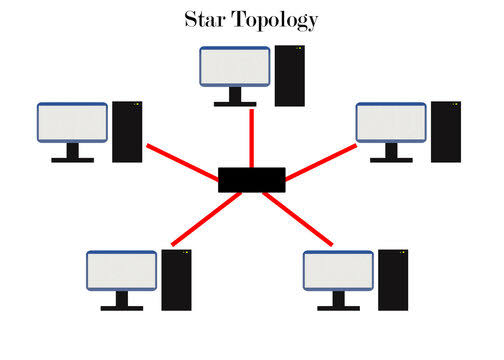
Imagine a network where all devices are connected to a single central point, like spokes on a wheel. This is the star network, a common topology in computer networking.
A star network is straightforward: each device, like a computer or printer, is directly linked to a central hub.
This hub acts as the traffic controller, managing all data flow between the connected devices. Why should you care about star networks?
Whether you’re setting up a home network or managing a large corporate network, understanding star networks is crucial.
It’s a foundational concept in networking, and it’s used in many different applications.
In this article, we’ll talk about star networks. We’ll explore their advantages and disadvantages, how they work, and where they’re most commonly used.
Table of contents
What is a Star Network?
A star network is a way of organizing a computer network where a central device, like a switch or a router, acts as the hub that all the other devices connect to.
These other devices, such as computers, printers, or other gadgets, are the peripheral nodes that communicate directly with the central hub.
The characteristics of a star network include:
- Central Node or Hub: This is the core of the network. It is the switch or router that manages all the data traffic.
- Direct Connections to the Central Node: Each device hooks up independently to the central hub, creating a star-like structure.
- No Direct Links Between Peripheral Nodes: Any communication between the connected devices has to go through the central hub.
Read Next: What is SSID Network? How to Find & Protect Yours
Advantages and Disadvantages of a Star Network
Star network has its own share of advantages and disadvantages, and they include:
Advantages:
- Easy to Install and Configure: Setting up a star network is relatively simple compared to other topologies, making it an attractive option for many users.
- Simplified Management and Troubleshooting: Since all devices connect through one central point, diagnosing issues and managing traffic becomes more straightforward.
- Centralized Control and Security: The hub allows for centralized monitoring of data traffic, enhancing security measures.
Disadvantages:
- Dependency on the Central Node: If the central hub fails, the entire network goes down, making it a single point of failure.
- Limited Scalability: Adding more devices can degrade performance as the hub gets overloaded.
- Single Point of Failure: Any problem with the central node disrupts the whole network.
How Does a Star Network Work?
Understanding how a star network operates involves examining its communication flow and the devices involved. Here’s how it works:
1. Communication Flow in a Star Network
- Peripheral Nodes Send Data to the Central Node: When a device wants to communicate with another, it sends data to the central hub.
- Central Node Receives and Processes the Data: The hub processes this information and determines where it needs to go next.
- Central Node Transmits Data to Appropriate Peripheral Node(s): After processing, the hub forwards the data to its intended destination among connected devices.
2. Networking Devices in a Star Network
- Central Node (e.g., Switch, Router, Server): This device manages all communications and can perform additional functions like routing or filtering data.
- Peripheral Nodes (e.g., Computers, Printers, Other Devices): These are the end-user devices that rely on the central node for communication.
- Connecting Cables (e.g., Ethernet, Fiber Optic): These cables connect each peripheral node to the central hub, facilitating data transfer.
3. Network Protocols and Standards
- Ethernet (IEEE 802.3): The most common standard for wired networks using star topology.
- Wi-Fi (IEEE 802.11): Wireless implementations of star networks are prevalent in homes and offices.
- Other Relevant Protocols: Various protocols can be employed depending on specific networking needs and configurations.
Read Also: What is a Mastermode? Definition and purpose in blockchain network
Applications of Star Networks
Star networks are versatile and are applied across various domains, such as:
1. Small-scale Networks (e.g., Home, Small Office): Ideal for home networks where multiple devices connect to a single router for internet access.
2. Enterprise Networks (e.g., Corporate, Campus): Commonly used in business environments to link computers, printers, and other equipment through centralized switches or routers.
3. Wireless Networks (e.g., Wi-Fi, Bluetooth): Many wireless setups adopt star topology principles by connecting devices through an access point or router.
4. Industrial Automation and Control Systems: Used in manufacturing environments where machines need reliable communication through centralized control systems.
Comparison to Other Network Topologies
When evaluating networking options, it’s important to compare star networks with other topologies.
Here is a tabular comparison of star network to other network topologies:
| Topology | Description | Advantages | Disadvantages |
| Star | All nodes connect to one central hub | Easy management; fault isolation | Single point of failure |
| Bus | All devices share a single communication line | Cost-effective; simple setup | Difficult fault detection; performance degrades with more devices |
| Ring | Each device connects to two others forming a circle | Predictable performance; easy troubleshooting | Failure in one device affects entire network |
| Mesh | Every device connects directly to every other device | Highly reliable; robust against failures | Complex installation; expensive |
Factors such as cost, scalability, reliability, and ease of maintenance should be considered when choosing an appropriate topology for specific needs.
Read Next: What Network is 08100 in Nigeria? | Network provider
Conclusion
Understanding what a star network is and how it operates is vital for effective network design.
Its centralized structure offers numerous advantages such as ease of management and enhanced security while also presenting challenges like dependency on the central node.
As technology evolves, so too will networking strategies; therefore, staying up-to-date on network topologies will be vital for future developments in this field.
Frequently Asked Questions
Yes, star topology offers good security because all data flows through a central switch or hub, making it easier to monitor network traffic and isolate issues quickly.
Yes, star topology can be implemented wirelessly using access points that serve as the central node connecting various wireless devices.
If the central hub fails, all connected devices will lose communication capabilities since they depend on this single point for data transmission.
Yes, hybrid topologies can be created by combining star topology with others like bus or ring configurations to meet specific networking needs.
References
www.javatpoint.com– What is Star Topology?
www.geeksforgeeks.org– What is Star Topology?
en.wikipedia.org– Star network
www.techtarget.com– Definition star network
Recommendations
What is Metropolitan Area Network? | Man Network
What is Roaming in Network? How Does it Work?